
TOKYO / CHUO
APA Hotel Hatchobori Shintomicho
APA Hotel Hatchobori Shintomicho
If you are travelling solo on business, or visiting Tokyo with light luggage, this hotel fits your trip: Shintomicho Station is close by, and Hatchobori gives you a JR connection. The trade-off is clear — the Standard packs a bed, desk and bathroom into 11 m², so if two of you do not want to take turns squeezing past each other, compare the Twin first. All 141 rooms are non-smoking, and the rooms are compact but complete.
Rooms and suitcase space
The Standard is 11 m² with one 140 cm bed and under-bed storage, for single or double use; two guests do not automatically get a bigger room. The Deluxe Twin is 21.8 m² with two 122 cm beds — the extra space and separate beds are real, but this room type has no under-bed storage.
Under-bed space takes the bags you will not need during the day, but opening two large suitcases every day in 11 m² is not comfortable. The bathroom is a compact unit, so taller guests and older travellers should weigh the shower space before booking. Nights are quiet and the bed sleeps well.
For two people who want separate beds, I would go straight to the Deluxe Twin; travelling alone with little luggage, the Standard’s under-bed storage is the more useful feature. Check the room name before you book, not just the price — the room name is the room you will get.
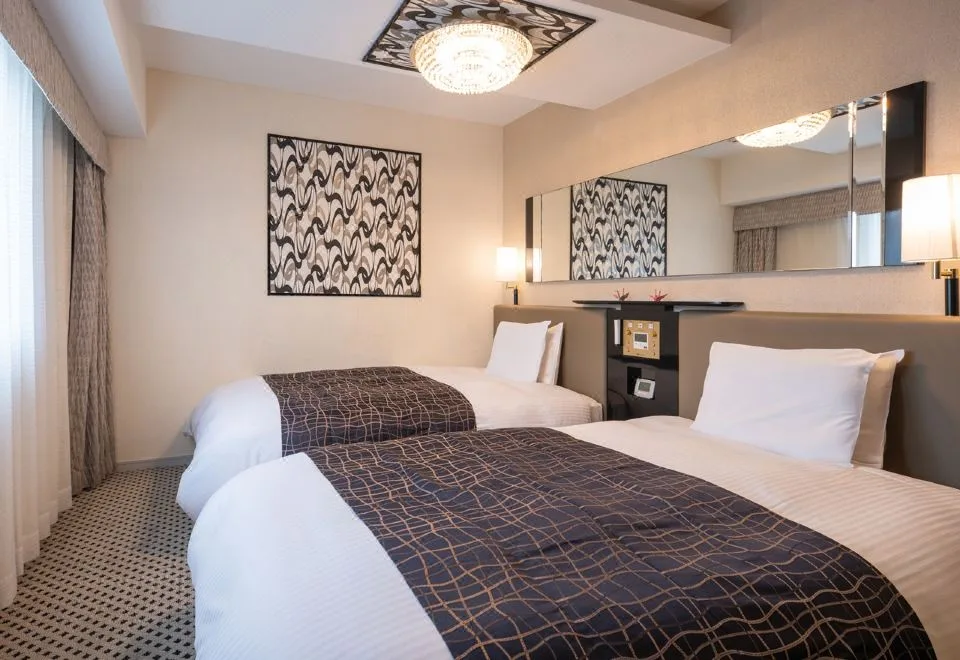
The Twin in the photo has two single beds side by side, an aisle by the window and a control panel at the headboard. Before you book, look at the beds, the seating and the aisle by the window, then match them against the room name on the booking page — sleeping in a room and sitting in it at the same time are two different things.
The room holds more than the outside suggests: every TV casts from your phone to the big screen in two taps, the bed is the APA Cloud fit mattress, and the headboard carries a central control panel, a power outlet and a USB charging port, while the blackout and heat-shield curtains keep daylight out completely. The air conditioning runs quietly, the room has an empty fridge, and some room types come with free bottled water, so a short stay needs no extra spending on the small things.
Bathroom setup
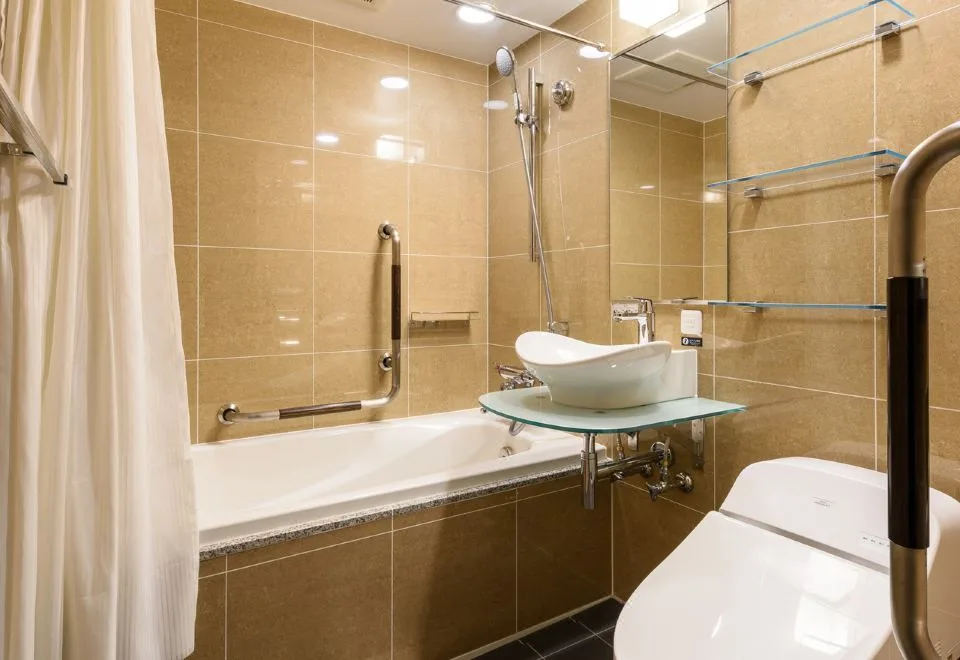
Bathtub, shower and sink share one room, and the photo shows grab bars beside the tub and a vessel sink. Two people getting ready at the same time will need to stagger, and you should also check the bathing setup of the room type you book.
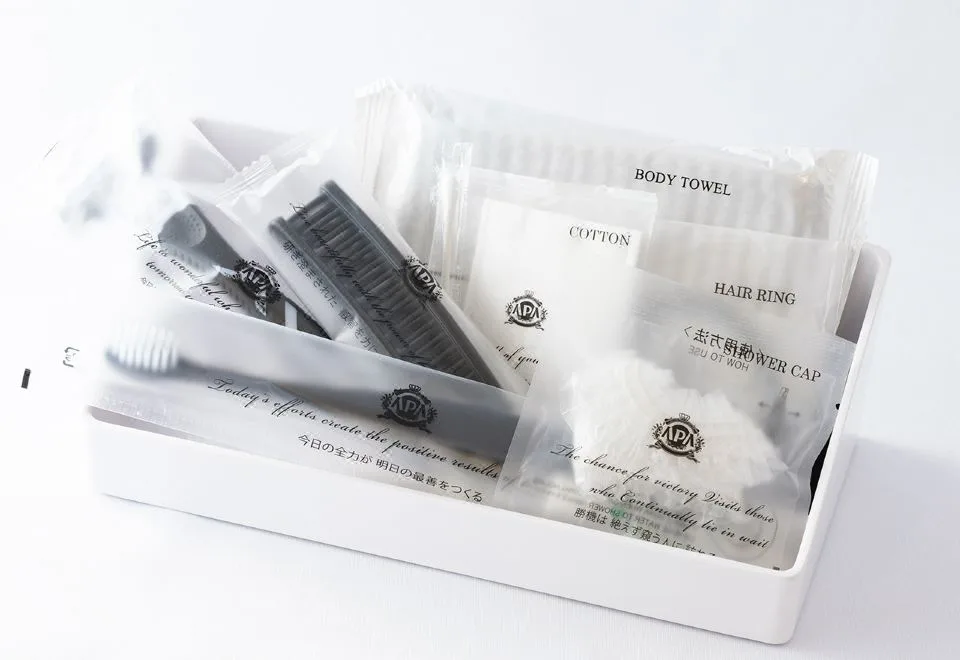
A unit bathroom keeps everything within reach — towels and amenities are right there after a shower — but the space is tight, so taller guests and older travellers should allow extra time getting in and out of the tub. Amenities come as a disposable set on a tray: toothbrush, comb, body towel, cotton pads, hair ring and shower cap, all single-use, so you do not need to bring your own.
There are grab bars beside the tub and beside the toilet, and the sink counter holds your toiletries. Older guests and anyone with limited mobility can ask first for a room with grab bars — getting in and out of the tub feels much safer with them.
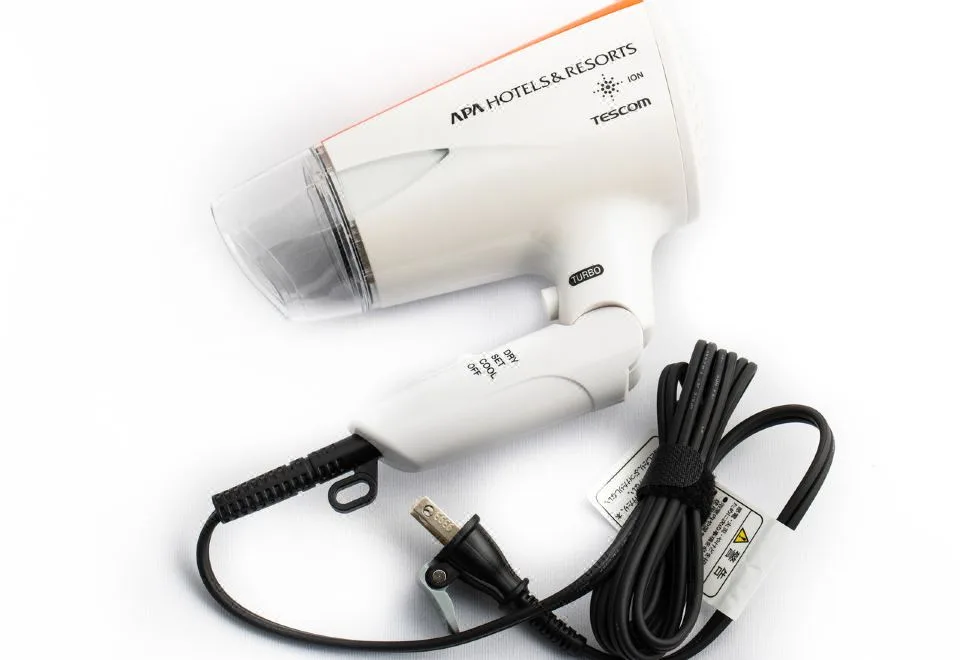
The bathroom is an egg-shaped unit bath with a metered water-saving tap and shower, and the shower pressure is strong enough to rinse off without waiting around. The toilet is a washlet, the towels are the thick luxury kind, two guests get towels in different colours, shampoo, conditioner and body soap are all provided, and the hair dryer is in the room, so nothing needs borrowing from the desk after a shower.
What to do about breakfast
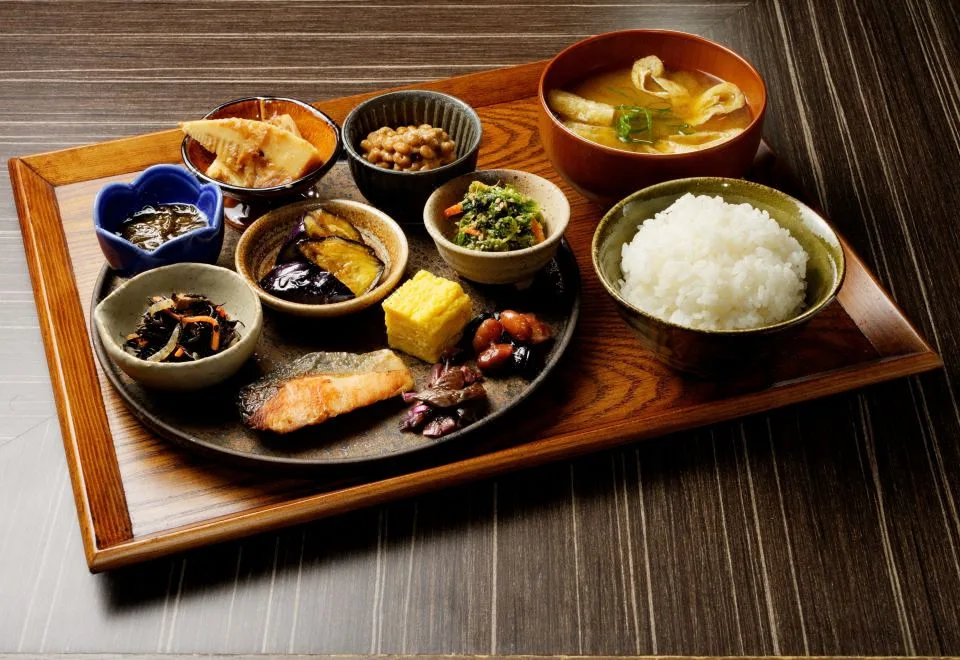
Breakfast runs 07:00 to 09:30, with last entry at 09:30, at 1,300 yen per person, the same price for children aged 17 and under. It is not a help-yourself buffet but a choice of two set meals; the Japanese set in the photo comes as one tray with grilled fish, rice, miso soup, natto and several small dishes.
The first-floor restaurant is Niboshi Soba Tori Soba Ai Shintomicho. Before you book a breakfast-included rate, check what is served and how you receive it. If you catch an early train, work out the timing first — do not discover at the door that breakfast has not started; late risers should also keep the closing time in mind, since after service ends you will be eating elsewhere.
For an early train, room-only with convenience-store food offers flexibility. If heading to Tsukiji for breakfast, you do not need to tie your wake-up time to the hotel’s breakfast hours.
Work out the breakfast-included price difference yourself: breakfast is ¥1,300 per person, so two people for two nights is four breakfasts. If you want a relaxed morning, book it included; if you want to sleep in and eat in Tsukiji, book room-only and add a convenience store — which one pays depends on what time you get up.
It pays to decide between the two breakfast sets in advance: the daily Japanese set is white rice, miso soup, ten small dishes and an ochazuke made with Ai dashi, with one free refill of rice; the ramen set is one of three ramen bowls with chashu takikomi rice and two small dishes. The kitchen is run by Ai, a Bib Gourmand pick in the Michelin Guide Kyoto for five straight years, so the ramen set is worth saving one morning for. Vegetarian choices are few, so ask first before adding breakfast if you eat vegetarian.
Stations, luggage and map
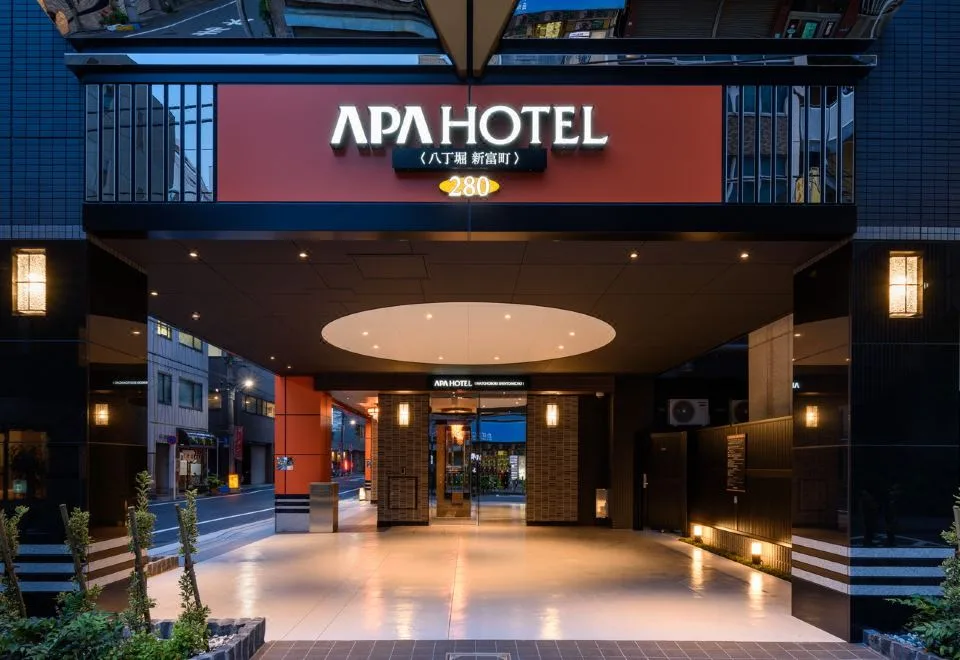
On foot it is about two minutes from Shintomicho Station Exit 5, or about five minutes from Hatchobori Station Exit A3. Several APA hotels stand nearby, so check the full name — Hatchobori Shintomicho — and the address rather than following the sign colour alone.
With large luggage, a wheelchair or a stroller, do not use Exit 5: the street elevator at Shintomicho is at Exit 1, and Tokyo Metro’s step-free route runs by elevator all the way from platform to gate to street. From Exit 1, walk to the hotel at Shintomi 1-17-8.
Hatchobori also has street elevators at Exits A2 and A3, reaching the gate concourse outside the ticket gates. On the JR Keiyo Line side, Exit B2 has an elevator and there is an elevator between platform and gate. On the Hibiya Line at Hatchobori, the platform-to-gate step is a staff-operated stair lift rather than an elevator, so allow extra time.
The airports need no detour either: about 50 minutes from Haneda and about 1 hour 40 minutes from Narita, both ending at Hatchobori Station. From Tokyo Station the Keiyo line reaches Hatchobori in about 7 minutes, and the same line runs straight to Maihama with no change. Drivers take the Shuto Expressway inner loop to the Kyobashi exit, about 4 minutes from the hotel.
Address: 1-17-8 Shintomi, Chuo City, Tokyo 104-0041, Japan. Google Maps directions
Nearby itinerary ideas
Combine a Tsukiji breakfast, an afternoon in Ginza and dinner around Hatchobori. For Maihama via the Keiyo Line, check the JR Hatchobori platform and entrance first — do not just follow the Hibiya Line signs.
Plenty is walkable: Ginza is about 310 m away, Tsukiji Outer Market about 810 m, Nihonbashi about 910 m and Tsukijigawa Park about 380 m. A little further, the Ginza Art Aquarium is about 1.1 km and Tokyo International Forum about 1.3 km, so a Tsukiji breakfast fits most easily into a one-night stay. Tsukiji Outer Market is liveliest in the morning, so walk straight over after breakfast; most Ginza shops open after ten, so leave the shopping for the afternoon. The old shops and department stores around Nihonbashi are worth half a day too, and nothing is far enough to stop you dropping bags at the hotel and heading out again.
One night or many nights
Check-in is from 15:00, check-out by 10:00, and the front desk is staffed 24 hours. Luggage storage is free and you can ask the desk for a wake-up call. If you arrive early or leave late, leave your bags at the desk rather than dragging them around while the room is not ready.
For a longer stay, ask first about cleaning, rubbish and towel arrangements; laundry goes through a delivery service. Children of all ages are welcome, and children aged 0–5 stay free without an extra bed; extra beds and cribs depend on the room type, so check the room details when you book. Pets are not allowed, service animals need advance application, and the guest checking in must be 18 or older.
One or two nights out all day is easy to understand; the longer you stay and the more luggage you carry, the more a Twin earns its keep. If your days are packed, treat the room as a place to sleep and store bags; if you want to eat slowly in the room and sort through shopping, the Twin’s desk and aisle space will serve you better.
Cleaning on a longer stay runs on an eco system: without a special request there is no full daily clean, but towels, bath towels, yukata, toothpaste, tea, paper cups, body sponges, cotton pads and cotton swabs are left at the door each day, sheets are changed every third night, and a cleaning request goes on the door handle before 09:00. A later check-out can be arranged by the hour at the desk for 2,000 yen an hour, and a 24-hour self-service laundromat sits about 4 minutes away on foot, so a long stay need not wait on the hotel laundry service. Families pick up amenities for children at the desk: toothbrush sets, slippers, body sponges, diaper-change sets, arm floats and picture books are all available to borrow in limited numbers, and none are placed in the room in advance.
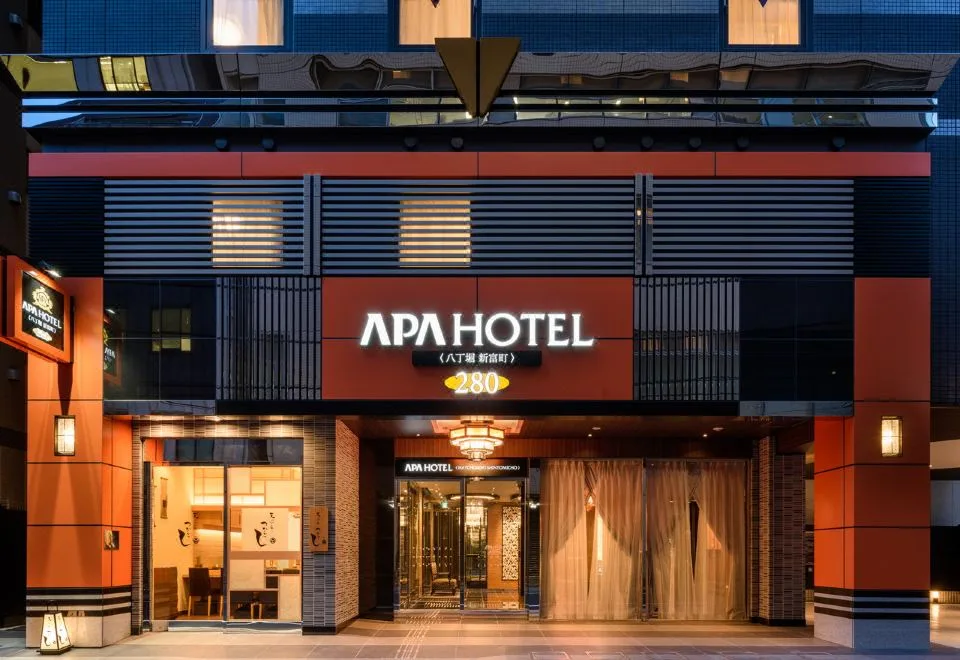
Exterior and common spaces
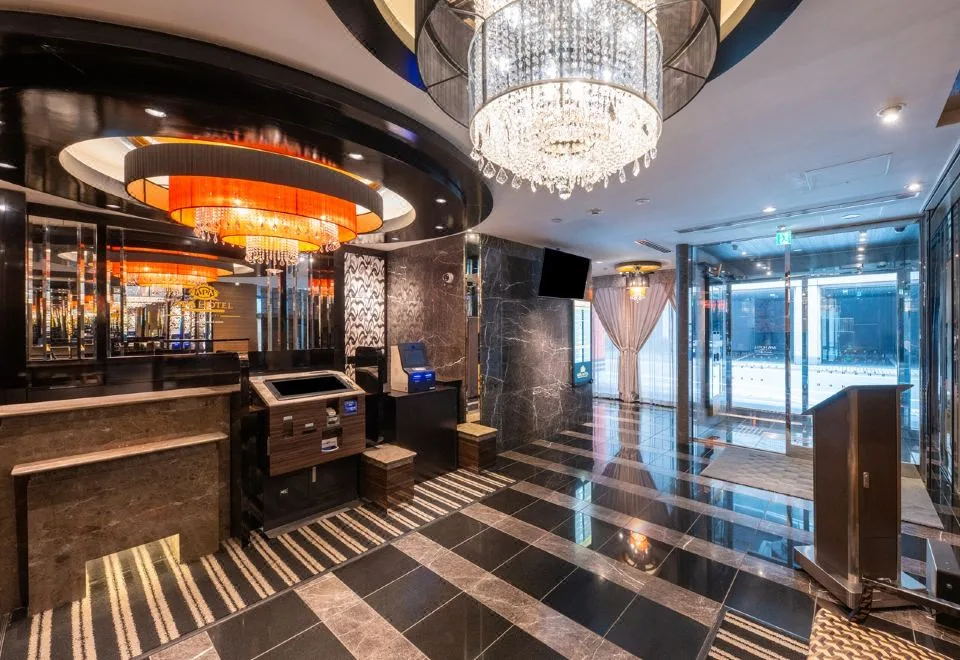
At the desk you get fast check-in and check-out, a safe, translation tools and a taxi service.
Public Wi-Fi is free, there is an elevator, a vending machine sells drinks, and public areas and floors are non-smoking, with a fresh-air system throughout.
For accessibility, a wheelchair is available on site and there are accessible rooms; for children, the hotel lists children’s slippers, toothbrushes and books or video. Safety facilities include a first-aid kit, fire alarm, access control, fire extinguisher and CCTV in public areas.
Check-in can go through the self-service machine: pay in advance in the phone app and scan the QR code, and check-in is done in one second, the way to go if you would rather not queue. The lift has security control, the second floor has an ice machine, a water dispenser and vending machines, a microwave is in the building, air purifiers, humidifiers, feather pillows and trouser pressers can all be borrowed, and check-out runs through the express lane. Parking is a single space reserved for wheelchair users, bookable in advance at 3,000 yen a night, so drivers should not leave it until arrival.
Advantages and trade-offs
Reasons to choose
For light-packed solo travel, the trade-off here works for me: the station is close, the storage is clever, and basic sleep and transport are covered. Quiet rooms, the bed and the help at the desk are the three strengths I would list, for anyone who puts basic sleep and transport first.
Things to accept
Two people with two large suitcases will find the Standard’s walking space tight, and under-bed storage does not make up for an aisle. Breakfast and check-out both run early, so if your days start late, work out the timing yourself.
Pros and cons at a glance
Pros
- Shintomicho Exit 5 is about two minutes on foot, Hatchobori Exit A3 about five, and the JR Keiyo Line reaches Tokyo Station in one stop.
- Shintomicho Exit 1 has a street elevator with a step-free route from platform to street; Hatchobori Exits A2 and A3 have street elevators too.
- The 11 m² Standard has a 140 cm bed and under-bed storage, practical for light-packed solo travel.
- Breakfast runs 7:00–9:30 at ¥1,300 per person, Western and Japanese.
- The front desk is staffed 24 hours, luggage storage is free, and wake-up calls are available.
- The building has an elevator, free public Wi-Fi, accessible rooms and a wheelchair on site.
Cons
- The Standard is only 11 m² — tight for two people and two large suitcases; the Deluxe Twin has no under-bed storage.
- The bathroom is a compact unit, so two people getting ready at once need to stagger.
- Breakfast ends at 9:30, so early trains and late risers need another plan; check the breakfast-included terms first.
- On the Hibiya Line at Hatchobori, the platform-to-gate step is a staff-operated stair lift, not an elevator.
- Some rooms still carry a lingering smoke smell — if you are sensitive to it, check with the front desk at check-in.
Information last checked: 2026-11-22